Categories: Articles, Pat Stevenson,
On January 1, 2026, New York City witnessed a moment that will be remembered for generations. Zohran Kwame Mamdani, community organizer, state assemblyman, democratic socialist, and son of immigrants, was inaugurated as the 112th mayor of the nation’s largest city. His swearing‑in marked a series of historic firsts: Mamdani became New York’s first Muslim mayor and its first Asian American mayor, as well as the first mayor hailing from the borough of Queens. His rise from a grassroots housing counselor to the city’s highest office reflects a political journey shaped by activism, progressive ideals, and a deep commitment to the working people of New York.
Mamdani’s inauguration unfolded in two symbolic acts. Just after midnight, he took his official oath of office at the decommissioned City Hall subway station, an architectural gem beneath Manhattan known for its vaulted ceilings and early‑20th‑century grandeur. With his hand placed on a Quran, Mamdani was sworn in by New York Attorney General Letitia James, accompanied by his wife, Rama Duwaji. The setting was intentional, a tribute to the city’s transit system, its workers, and the millions of New Yorkers who rely on it daily.
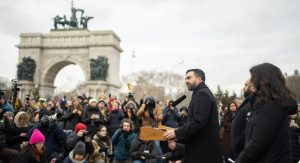
Later that afternoon, a larger public ceremony took place on the steps of City Hall, where U.S. Senator Bernie Sanders administered the oath in front of thousands of supporters, activists, and community leaders. Representative Alexandria Ocasio‑Cortez introduced Mamdani, underscoring the progressive movement that helped propel him to victory.
The day culminated in a seven‑block street celebration – part block party, part political rally, reflecting the grassroots energy that defined his campaign.
In his inaugural address, Mamdani declared that his administration would “govern expansively and audaciously,” signaling a bold progressive agenda for the city’s future. He spoke directly to New Yorkers who felt disillusioned with politics, promising a government that would “be a mayor for all New Yorkers” and restore faith in public institutions.
Highlights of Mamdani’s Address:
1. Affordibility
and Housing
Mamdani emphasized that housing would be the cornerstone of his administration. He pledged to expand tenant protections, accelerate the construction of affordable housing, and confront the city’s affordability crisis head‑on. His first executive orders, issued the following day, focused on housing and tenant rights, underscoring the urgency of the issue.
2. Public Transit as a
Public Good
Referencing his midnight swearing‑in at the historic subway station, Mamdani reiterated his commitment to improving and expanding public transit. He advocated for a future where buses are free, subway service is more reliable, and transit workers are better supported—ideas he championed during his campaign.
3. A Government for
the Working Class
Mamdani framed his administration as one that would center the needs of working‑class New Yorkers. He spoke of universal child care, rent freezes for vulnerable tenants, and a city government that would no longer “shrink from the scale of its responsibilities”.
4. A New Era of
Inclusive Leadership
As the first Muslim and Asian American mayor, Mamdani acknowledged the symbolic weight of his election. He spoke about the importance of representation, the struggles of immigrant families, and the promise of a city where every child—regardless of background—can see themselves reflected in its leadership.
Mamdani’s election is a watershed moment in the city’s political history. Born in Kampala, Uganda, on October 18, 1991, he immigrated to the United States and became a citizen in 2018. His parents, renowned scholar Mahmood Mamdani and acclaimed filmmaker Mira Nair, instilled in him a deep awareness of global politics, culture, and justice.
His identity as a Muslim and South Asian American shaped both his political worldview and the coalition that supported him.
Before becoming mayor, Mamdani served as the New York State Assembly member for the 36th District, representing Astoria, Queens, from 2021 to 2025. His political career began not in elected office but in community organizing. He worked as a housing counselor, helping tenants navigate eviction threats and predatory landlord practices—experiences that later informed his legislative priorities.
During his tenure in Albany, Mamdani became known for his advocacy on:
Housing justice, including good‑cause eviction protections
Public transit improvements, especially bus system reforms
Immigrant rights, including expanded language access
Progressive taxation, aimed at funding social services
His alignment with the Democratic Socialists of America and the Working Families Party positioned him as a leading voice in New York’s progressive movement.
Mamdani’s mayoral campaign was initially viewed as a long shot. But his message—centered on affordability, dignity for working people, and a transformative vision for city government—resonated widely. His grassroots organizing background helped him build a broad coalition of tenants, transit riders, young voters, and progressive activists.
By the time he won the election, Mamdani had become a national figure, symbolizing a new generation of left‑leaning urban leadership.
The day after his inauguration, Mamdani began his first full day as mayor by taking the subway from his modest Queens apartment to City Hall—bundled against the cold, fighting off what appeared to be a winter cold, and greeting neighbors along the way. The moment captured the essence of his political identity: a mayor who lives like the people he serves.
Zohran Mamdani’s mayoralty begins at a moment of profound challenge and opportunity for New York City. His administration promises sweeping changes—some ambitious, some controversial, all rooted in a belief that the city can and should do more for its residents.
Whether his bold agenda succeeds will depend on political negotiation, public support, and the city’s economic realities. But one thing is clear: Mamdani’s election marks a turning point. His leadership represents not only a shift in policy but a reimagining of who can lead New York City and what that leadership can look like.