Categories: Pat Stevenson,
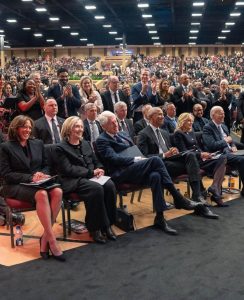
A solemn, reflective atmosphere settled over Chicago as thousands gathered to honor the life and legacy of Rev. Jesse Jackson, whose decades of civil rights leadership shaped national conversations on justice, equality, and political empowerment. The funeral drew an extraordinary assembly of political
figures, past and present, underscoring the breadth of Jackson’s influence. Among those in attendance were President Joe Biden, President Barack Obama, President Bill Clinton, and former Secretary of State Hillary Clinton, each offering remarks that highlighted different dimensions of Jackson’s long public journey.
The service, held at a historic South Side church deeply connected to Jackson’s activism, opened with tributes from local leaders and members of the Rainbow PUSH Coalition. They spoke of Jackson’s early organizing, his work alongside Dr. Martin Luther King Jr., and his lifelong commitment to expanding opportunities for marginalized communities. Their reflections set the tone for a ceremony that blended personal remembrance with national significance.
President Biden spoke first among the former presidents, emphasizing Jackson’s role as a moral force who consistently pushed the country toward a broader vision of democracy. He noted that Jackson’s advocacy—whether on voting rights, economic justice, or international diplomacy—often challenged political leaders to confront uncomfortable truths. Biden described Jackson’s voice as one that “never stopped insisting that America live up to its promise,” framing his legacy as both inspirational and demanding.
President Obama followed with a deeply personal reflection, recalling how Jackson’s presidential campaigns in the 1980s expanded the political imagination for a new generation. Obama highlighted the way Jackson built multiracial coalitions and insisted that diverse communities deserved a seat at the table. He spoke of Jackson as a mentor figure whose example demonstrated that activism and electoral politics could reinforce one another. Obama’s remarks emphasized the enduring relevance of Jackson’s message in contemporary struggles for justice.
President Bill Clinton offered a perspective shaped by decades of collaboration and occasional political tension, focusing on Jackson’s persistence and global reach. He recounted Jackson’s humanitarian missions, including efforts to negotiate the release of hostages abroad, describing him as someone who believed diplomacy and compassion could coexist. Clinton underscored Jackson’s ability to connect with people across ideological and geographic boundaries, portraying him as a bridge-builder during moments of national division.
Hillary Clinton added her own tribute, centering on Jackson’s work to empower young people and expand civic participation. She recalled his tireless efforts to register voters, support emerging leaders, and advocate for educational equity. Her remarks framed Jackson as a figure who understood that democracy depended on broad participation and that leadership required nurturing the next generation.
Throughout the service, the recurring theme was the breadth of Jackson’s impact—from the pulpit to the streets, from Chicago to the global stage. Speakers emphasized that his legacy was not confined to any single movement or moment but was woven into the fabric of modern American political and social life.
As the ceremony concluded, the crowd rose in a long, resonant standing ovation, honoring a leader whose voice shaped decades of national dialogue. The gathering of presidents, political leaders, activists, and community members reflected the profound imprint Jesse Jackson left on the country he spent his life urging toward justice.