Categories: Pat Stevenson,
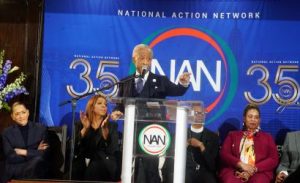
Harlem gathered in solemn celebration this past Saturday, February 21, as community leaders, elected officials, artists, and longtime allies honored the life and legacy of Rev. Jesse Jackson. The tribute, held just days after Jackson’s passing last week, drew a crowd that reflected the breadth of his influence across civil rights, politics, and American culture. The event was sponsored by Rev. Al Sharpton’s National Action Network, an organization that has long worked in parallel with Jackson’s own advocacy for racial justice and economic equality.
The atmosphere inside the venue blended grief with gratitude. Attendees spoke not only of loss but of the enduring power of Jackson’s message and the decades he spent pushing the nation toward a more inclusive vision of democracy. His well known rallying cry, “Keep Hope Alive,” echoed throughout the program as speaker after speaker reflected on how those words shaped movements, inspired generations, and fortified communities during moments of national crisis.
Mayor Mandami, spoke about Jackson’s influence on urban communities and his unwavering commitment to confronting inequality. He described Jackson as a “moral compass” whose voice remained steady even when the political winds shifted.
Rev. Al Sharpton closed the tribute by situating Jackson within the broader arc of the civil rights movement. He described Jackson as a bridge between eras, someone who marched with Dr. Martin Luther King Jr. and later mentored younger activists navigating the complexities of modern social justice work. Sharpton reminded the audience that Jackson’s legacy was not only historical but instructive, offering a blueprint for the struggles that remain.
As the program concluded, the crowd rose in a standing ovation, a final collective gesture of respect for a man whose life was defined by service. In Harlem, a neighborhood that has long been a heartbeat of Black political and cultural life, the message was unmistakable: Jesse Jackson’s hope lives on, carried forward by those committed to the work he championed for more than half a century.
Rev. Dr. Jesse Louis Jackson Sr. leaves behind a legacy that reshaped the moral and political landscape of the United States. For more than six decades, he stood at the forefront of the struggle for civil rights, economic justice, and global human dignity. His life’s work formed a bridge between the generation of Dr. Martin Luther King Jr. and the movements that followed, ensuring that the call for equality never lost its urgency or its moral force.
Born in Greenville, South Carolina, Jackson rose from the segregated South to become one of the most influential voices of the 20th and early 21st centuries. As a young activist, he joined the Southern Christian Leadership Conference and became a close aide to Dr. King. After King’s assassination, Jackson helped carry forward the unfinished work of the movement, founding Operation PUSH and later the Rainbow Coalition—organizations that expanded the fight for justice into economic empowerment, voter registration, and broad-based political participation.
Jackson’s presidential campaigns in 1984 and 1988 broke new ground, energizing millions of voters who had long been marginalized. His “Rainbow Coalition” became a model for multiracial, multiethnic political organizing, demonstrating that American democracy grows stronger when more voices are included. His speeches, rooted in biblical cadence, moral clarity, and unyielding hope, became touchstones for generations seeking courage in the face of adversity.
Beyond domestic politics, Jackson emerged as a global humanitarian. He negotiated the release of hostages abroad, advocated for peace in conflict zones, and consistently urged the world to recognize the dignity of all people. His work earned him international respect and cemented his reputation as a tireless advocate for the oppressed.
Throughout his life, Jackson remained committed to the belief that America could live up to its highest ideals. He championed voting rights, labor rights, educational equity, and economic opportunity, insisting that progress required both protest and policy. Even as he faced personal health challenges later in life, he continued to mentor young activists and speak out against injustice.
Rev. Dr. Jesse Jackson’s legacy endures in the movements he inspired, the institutions he built, and the millions he empowered. He leaves behind a nation profoundly shaped by his vision of justice, inclusion, and hope, a vision he urged all of us to carry forward.
photos by: Seitu Oronde