Categories: Articles, Pat Stevenson,
From the 1700s through the late 1800s, Black communities across what became the United States built self sustaining towns that stood as powerful expressions of freedom, autonomy, and collective strength. These towns, some founded by free Black people, others by formerly enslaved families, were often economically vibrant, politically independent, and culturally rich. Yet many were violently destroyed through arson, bombings, and massacres carried out by white mobs who viewed Black prosperity as a threat to the racial order of the time.
Even during the colonial era, free Black people carved out pockets of autonomy. Communities such as Fort Mose in Spanish Florida, founded in 1738, became the first legally sanctioned free Black town in North America. Residents built homes, cultivated land, and defended their settlement from British attacks. Though Fort Mose was eventually destroyed during warfare, its existence demonstrated that Black self-governance was possible even under oppressive conditions.
After the Civil War, Reconstruction opened a brief window in which Black Americans could build independent lives on their own terms. Thousands purchased land, established businesses, and founded towns that reflected their aspirations for safety and prosperity. Places like Nicodemus, Kansas; Mound Bayou, Mississippi; and Langston, Oklahoma became symbols of Black achievement.
These towns were not merely residential spaces—they were ecosystems. Residents built schools, churches, banks, farms, and newspapers. Many were governed entirely by Black elected officials. Their success challenged the racist myth that Black people were incapable of self-rule. Some towns were wiped out completely. Others survived but never recovered their former strength. In many cases, local governments refused to prosecute attackers, effectively sanctioning the violence.
Despite the devastation, the legacy of these towns endures. They represent a long tradition of Black resilience, ingenuity, and determination to build spaces of dignity and self-determination. Their destruction reveals the lengths to which white supremacist systems went to suppress Black progress, but their memory continues to inspire movements for justice and community empowerment today.
Across early America, Black people, both free and formerly enslaved, built independent towns that demonstrated extraordinary resilience, political autonomy, and economic strength. These communities were often self governing, economically productive, and culturally rich. Yet many were violently destroyed by white militias, mobs, or government forces who viewed Black independence as a threat to the racial hierarchy.
Fort Mose, founded in 1738, was the first legally recognized free Black town in what is now the United States. It was established by formerly enslaved Africans who escaped from British colonies and were granted freedom by the Spanish in exchange for military service. The town had more than 20 households and blended African, Spanish, and Native American cultural traditions. It was destroyed during warfare between the British and Spanish, forcing residents to flee, though its legacy as a free Black settlement remains significant.
Throughout the 1700s, maroon communities, settlements of people who escaped enslavement, flourished in remote regions. Pilaklikaha, Florida, also known as “Abraham’s Old Town,” was a prominent Black Seminole settlement in Florida. These communities were self sufficient, with agriculture, trade networks, and political alliances with Native nations. Many were destroyed by U.S. military campaigns aimed at eliminating havens for freedom seekers. The Negro Fort, another major maroon stronghold, was destroyed by U.S. forces in 1816 using a massive explosion that killed hundreds of Black and Native residents.
Nicodemus was one of the most successful Reconstruction era Black towns. Founded by formerly enslaved families seeking safety and opportunity, it developed farms, businesses, churches, and a vibrant civic life. Unlike many other towns, Nicodemus survived violent backlash, but it faced severe economic sabotage and discriminatory policies that stunted its growth. Though not destroyed by mob violence, it stands as a symbol of what Black self governance could achieve when allowed to flourish.
Although slightly outside the 1800s, Rosewood’s destruction reflects the same pattern of violence that targeted earlier Black towns. Rosewood, Florida was a prosperous, self contained Black community with businesses, landowners, and a strong local economy. In 1923, white mobs burned the town to the ground and killed residents after false accusations against a Black man. Its destruction mirrors the earlier pattern of erasing Black prosperity through terror.
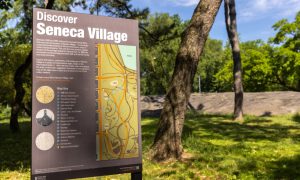
Seneca Village, NY was a prosperous Black landowning community in Manhattan. Residents built churches, cemeteries, and schools, and many owned property at a time when land ownership was tied to voting rights. The town was destroyed when New York City seized the land through eminent domain to build Central Park. Homes were razed, families displaced, and the community erased from maps.
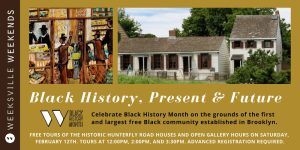
Weeksville, Brooklyn was a thriving free Black community with its own newspaper, schools, churches, and political organizations. While not destroyed by a single violent event, it suffered from encroaching development, racial hostility, and displacement. Its decline reflects the quieter but equally destructive forces of urban expansion and systemic racism.
After emancipation, formerly enslaved families founded dozens of self contained towns such as Freedmen’s Town (Houston), Quakertown (Denton), and Clarksville (Austin). These communities built schools, businesses, and churches. Many were later destroyed or displaced by white city governments through forced removal, land seizures, or “urban renewal” projects.
Colfax, Louisiana became a center of Black political power during Reconstruction. Black residents held local offices and defended their right to vote. In 1873, white paramilitary groups attacked the town, killing more than 100 Black residents in what became known as the Colfax Massacre. The massacre crushed Black political control and marked a turning point in Reconstruction’s collapse.
Hamburg, South Carolina was a majority Black town with Black elected officials and a strong militia. During the Hamburg Massacre, white militias attacked the town, killing several Black leaders and driving residents out. The town was effectively destroyed, and its land was later taken over by white landowners.
One of the most successful Black towns of the Reconstruction era, Nicodemus, Kansas featured farms, businesses, churches, and a strong civic culture. While it was not destroyed by mob violence, discriminatory policies and economic sabotage undermined its growth. It remains a symbol of Black resilience.
Founded by formerly enslaved people, Mound Bayou, Mississippi became one of the most economically successful Black towns in the South, with banks, schools, farms, and hospitals. Although it survived outright destruction, it faced constant threats, including attempted arson, economic isolation, and white supremacist violence aimed at undermining its prosperity.
Greenwood emerged in the early 20th century as one of the most prosperous Black communities in the United States, built by formerly enslaved people and their descendants who created businesses, newspapers, schools, and a thriving middle class. Known as “Black Wall Street,” it symbolized Black economic independence during segregation. In 1921, a false accusation against a young Black man triggered white mobs to invade the district. Over two days, they burned homes, looted businesses, and killed many residents while authorities failed to intervene. The destruction erased decades of Black wealth and left thousands homeless, permanently altering the community’s trajectory.
Rosewood, Florida was a small but self-sufficient Black town founded by formerly enslaved families who built churches, schools, and successful businesses in rural Florida. Residents owned land, worked as farmers and tradespeople, and maintained a close-knit community despite the racial tensions of the Jim Crow South. In 1923, a white woman’s accusation against a Black man, never proven, sparked escalating white mob violence. Over several days, mobs burned homes, killed residents, and forced survivors to flee into nearby swamps. The town was completely abandoned, its land seized or sold off, and its history suppressed for decades, leaving generational trauma and loss.
Elaine, Arkansas was home to Black sharecroppers who lived under exploitative labor conditions that kept them in debt to white landowners. In 1919, Black farmers began organizing to demand fair payment for their cotton, forming a union to challenge the system. Their efforts were met with hostility, and a confrontation at a meeting site led to white mobs and federal troops descending on the area. Over several days, widespread violence targeted Black residents, resulting in one of the deadliest racial massacres in U.S. history. The violence crushed the organizing movement, reinforced economic oppression, and devastated the Black community for generations.
Springfield, Illinois had a growing Black population in the early 1900s, drawn by job opportunities and the hope of escaping Southern racial violence. Despite this, racial tensions simmered as Black residents competed for work and challenged segregation. In 1908, false accusations against two Black men ignited white mob violence. Rioters destroyed black homes and businesses, lynched two Black men, and forced many families to flee. The destruction shocked the nation because it occurred in Abraham Lincoln’s hometown, undermining assumptions about Northern racial tolerance. The event’s brutality helped inspire the founding of the NAACP, marking a turning point in civil rights activism.
African Americans built numerous self sufficient communities across the United States from the 1700s through the 1900s, many of which were violently destroyed by white supremacists. Yet these communities rebuilt again and again, demonstrating extraordinary resilience. The continual pattern of creation, destruction, and renewal reflects a strength that has shaped the nation’s pursuit of justice. For generations, the Black community has led the fight for civil rights and democracy, often at tremendous cost. They have every reason, in the words of the late Jesse Jackson, to “Keep Hope Alive,” carrying forward a legacy of perseverance and determination.